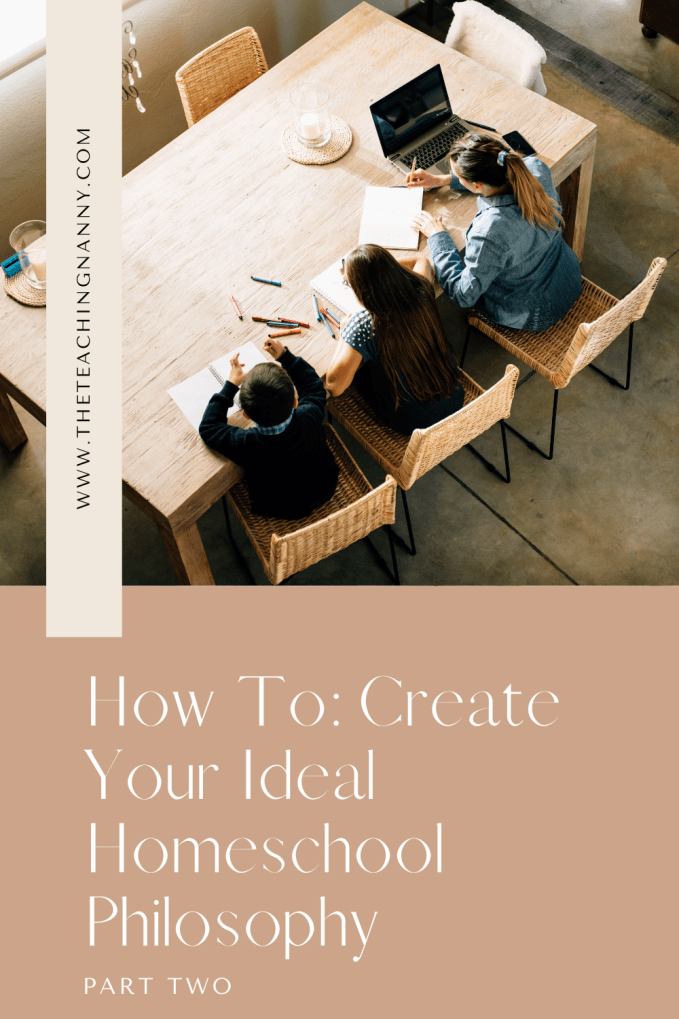
Welcome to part two of our series on How to Create an Ideal Homeschool Philosophy! If you missed part one, you’ll find it here It will be really beneficial for you to read that first before we dive into the different types of homeschooling curriculum.at

Now that you’ve deschooled, observed your child, written down all the how’s and why’s and researched all the things let’s talk about the different forms of educational pedagogy.
I’m going to break down the top six homeschool styles from a very positive viewpoint. I don’t believe in dwelling in the negative especially in home education. What works for one family won’t work for another. Just understand that the type of homeschooler you are can become very personal and can be worn as an identity. It’s often the first question homeschool parents ask each other! I will tell you which type of family would benefit from each philosophy. Remember that this is based on my own personal opinion and some research on each style! I will be sharing the books I recommend for each style at the end of this post.
Teaching methods can run the gamut of schooling at home to unschooling. We’ll start with the most structure and move through our way to unschooling (possibly the most misunderstood method, in my personal opinion!)
School at Home (AKA Traditional)
This method has come into more recent fashion during and after the pandemic. School at Home boils down to recreating the classroom at home. This could be homeschooling through a public online school (Like K-12) or using a full grade level curriculum from a textbook publisher. No matter how you choose to implement this method, it will look and feel more like a grade school classroom.
School at Home works great for:
- People who live in or need to move to a state with more homeschool guidelines and laws
- Parents who are unsure of what and how to teach and want to make sure their children are “on track”
- Families who need to re-enter the public school system
- Children who benefit from structure and deadlines
- Children who need/want to graduate early
Classical Education
Classical education at its foundation teaches children how to think rather than what to think. Children move through a very specific path of learning called the Trivium which means Three Roads or Three Ways. Students will work through three stages of development throughout the course of their education.
Grammar Stage (roughly kindergarten through third grade)– Mastering reading, writing, math
Logic or Dialectic Stage (roughly fourth grade through middle school)-Applying and connecting knowledge in a systematic way
Rhetoric Stage (roughly high school through college)-Expressing ideas logically, eloquently and persuasively
There is a large focus on memorizing and teaching the basics of reading, writing, math, geography, history, science, and fine arts.
Classical Education works great for:
- Parents who want to teach their children about the past and how it affects the present
- Parents who want to give the basics of education to their child while exposing them to great art, music and literature
- Parents who are able to learn alongside their children (A huge plus if you want to learn ancient languages like Latin, and Greek!)
- A support network like Classical Conversations and other Classical School Models
Full disclosure: Lux et Vita uses the classical model for our co-op curriculum because it provides a wonderfully rich foundation for children and families. We do not require parents to adhere to the classical model at home! We love and use an enrichment curriculum from Memoria Press to help guide our lessons and learning.
Charlotte Mason
The Charlotte Mason method is probably the most beautiful of all the types of homeschool! The emphasis on beauty, nature, and the home creates a cozy picture of close knit families learning together. This method focuses on learning from real life. Children are given short lessons in the morning with the expectation that they will choose various creative pursuits during the rest of the day. The focus is mainly on the family and the home. Children are given chores at an early age along with the skills needed to learn handicrafts. Families are encouraged to stay away from Twaddle these are pursuits or books that are time fillers and thus provide very little meaning in the life of the family.
Children will learn through narration. You will read a short passage to your child who is expected to repeat back a short summary. As the child grows, narration turns into written compositions. Charlotte Mason is grounded in Biblical Christianity with the children’s motto being I am, I can, I ought, I will. And the parent’s motto follows as education is an atmosphere, a discipline, a life.
Charlotte Mason works great for:
- Families who enjoy being outdoors
- Families who appreciate good quality books
- Self motivated parents and children who are able to listen to and go through the narration process!
- Families who want to create a home that children contribute to along with parents
Unit Studies
This method takes a specific theme, like rainforest or dinosaurs, and creates all lessons around that topic. Parents will organize all work in each subject area around the chosen theme.
A rainforest theme might include, learning the layers of a rainforest, what animals call it home, locating different rainforests on maps, researching products made from the rainforest, deeply researching an individual animal, learn vocabulary words, read books about and from the region, etc.
Unit Studies work great for:
- Families with different age groups
- Families who like to learn together
- Parents who are able to create units from other resources (this is the pinterest mom dream method!)
- Parents who can tailor a unit for each child’s needs
- Children who are hands-on learners
Unschooling
Like I said earlier, this is by far the most misunderstood type of homeschooling! Personally, this is the camp I fall into the most. Unschooling is probably not what you think! Children are not running around without supervision terrorizing the neighborhood. Instead, they are taught through rich educational experiences and being able to explore as much as possible.
Unschooling is natural, child-led and self-directed learning. Parents provide an educationally rich environment with child-centered learning materials and lots of time spent assisting the child through whatever they want to learn. An unschooling parent has spent a lot of time observing their child to help facilitate quality learning experiences. It is meant to encourage life-long learning as a habit which includes lots of play with hands-off parenting. You will usually find free age mixing where children are learning from each other.
Unschooling is great for:
- A Trustful Parent-someone who isn’t going to get in the way of a child’s independence while playing or working
- The highly motivated child
- Families who value free thinking
- A family who can find other like minded parents and children who are able to interact together without adult intervention
Eclectic
Honestly, this is the type of homeschooling most families find themselves using! This is just a mixture of all the types of schooling I’ve mentioned. Maybe you unschool in the winter and spring when the Texas weather is at it’s finest but settle in for a great unit study in the summer and fall! Classical and Charlotte Mason share a lot of similar philosophies regarding using living books as textbooks. While unit studies can be placed inside any type of method! You might change your method as your children grow or your family needs change.
Eclectic works great for:
- Families who value individual methods of education
- Children who don’t learn like their siblings
- Families who are able to figure out their child’s unique learning style
- Families who like to change it up as their children age and mature
Others
There are a few types of parenting methods that get lumped into homeschooling. I’ll mention them here quickly. If you’re interested in these types of methods, I suggest doing your own research because they really fall into the category of family method over an educational curriculum.
The types I consider family methods rather than curriculum are Montesorri and Waldorf/Steiner.
These styles lend themselves more to an entire family wide approach to keeping a home and educating children. They focus on child developmental stages and specific tools given at the correct stages or sensitive periods.
Take Aways
What you choose today doesn’t have to be the plan you follow in 6 months! I love the adage: Each child, each year. After that year, reevaluate by talking to your kids or spouse to find out what worked and what didn’t.
From the beginning tell yourself you will give it at least six months before you stop a curriculum or give up on something.
Find other like minded families so you can share curriculum or ideas. Lux et Vita is a great place to start!
Remember your non-negotiables when things get hard.
The better you know and understand your child, the better you can educate them. Keep your notebook handy every day so you can jot down observations or quotes from your kids that make you laugh!
Resources
Here are the best books I have found on each type of homeschooling. This list is short for a reason, I hate being overwhelmed when I have to make a huge decision. Feel free to do your own research!
Charlotte Mason Education: A Home Schooling How-To Manual by Catherine Levison
The Core: Teaching Your Child the Foundations of Classical Education by Leigh A. Bortins
The Brave Learner: Finding Everyday Magic in Homeschool, Learning, and Life by Julie Bogart
How Toddlers Thrive: What Parents Can Do Today for Children Ages 2-5 to Plant the Seeds of Lifelong Success by Tovah P. Klein
The Importance of Being Little: What Preschoolers Really Need from Grownups by Erika Christakis
Feel free to share this valuable information with others who could benefit from it!

Discover the Perfect Companion Articles for You!
- Walking in His Ways: A Family Journey Through Lent 2025
- Back to Basics: Fine Motor Play
- Back to Basics: Gross Motor Play
- Back to Basics: Water Play
- Back to Basics: Rice Bins


 The Teaching Nanny